
With the re-release of Edward Yang’s “Yi Yi” in 4k, I wanted to revisit the film. I say with confidence that it is one of the greatest films ever made. It has never left my four favourites. Every time I watch it, I find something new in it. I look at myself, the world, and my parents differently, and I think back to when I was a teenager. It makes me leave no stone unturned.
“Yi Yi” tells the story of a family in Taiwan, N.J a father and husband who works in a job he does not like, his teenage daughter Tin Tin, who is discovering “first loves” and growing up isolated from her family and finally Yang Yang, his young son who is fond of taking photos of people and asking questions about the world. How all three try to navigate their lives and their own mistakes is beautiful.

The film is framed by the two big events that follow every family: it begins with a wedding and, over its three-hour journey, concludes at a funeral. What happens in the vast space between is a beautiful showcase of the human condition—capturing the slow ache of heartbreak, the weight of growing old with regrets, and the quiet dignity of accepting a path once chosen in error. However, Yi Yi never shouts. Yang rejects the ‘Hollywood’ school of acting, stripping away the artificial machine of screaming matches and the manipulative intimacy of the ‘Oscar-moment’ close-up. He understands that life’s most profound shifts don’t happen in a spotlight, but in the silence of the mundane
The power of Yi Yi lies in Yang’s restraint. He rips apart the ideal cinematic ideas of cuts and close-ups we are used to, often placing the camera behind a glass partition or at a distance that forces us to squint at the reflection. This isn’t cold detachment; it is a recognition of human boundaries. In our daily lives, we don’t “cut” to a close-up of a loved one’s face to understand their grief; we watch them from the doorway, observing how they occupy a room. Yang understands that our instinct is not to invade, but to watch the world go by from a distance. By refusing to go “inside” the room, he captures how humans actually feel rather than making it a massive Hollywood spectacle, reminding us that while these lives are unfolding before us, they are ultimately their own, not ours. We are not their family, so we are not in the room with them. We don’t have the right to see them up close.
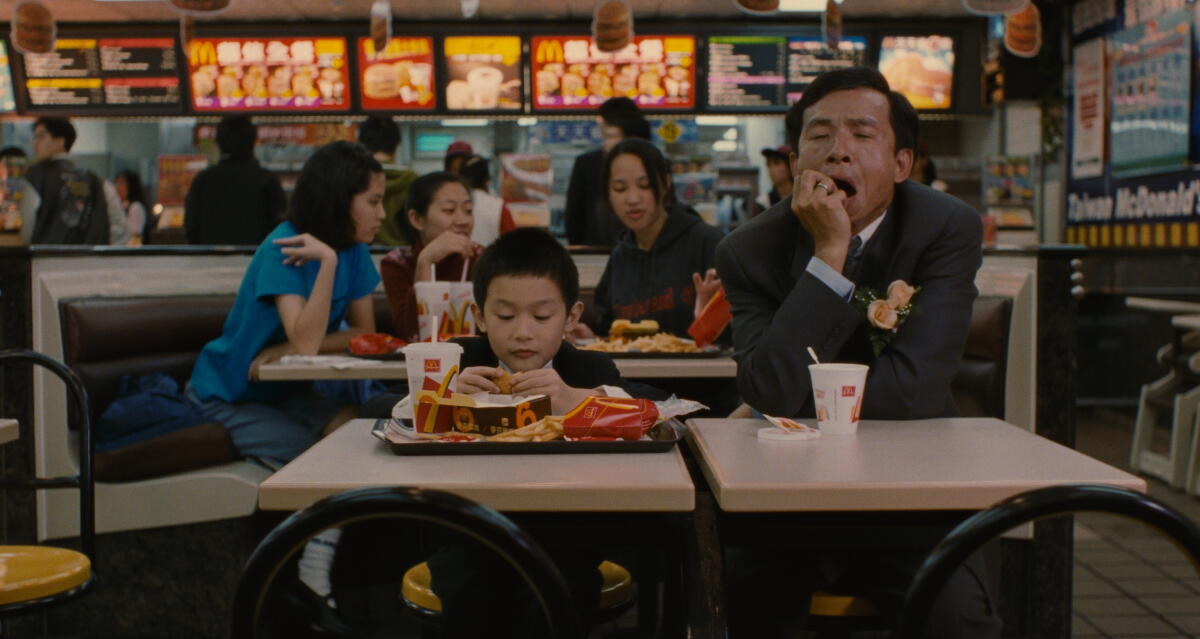
This concept of the “half-truth” finds a place in Yang Yang’s photography, but it is Yang’s directorial eye that bears the other 50%. By positioning the camera outside of a window or at the end of a long hallway, Edward Yang essentially photographs the “back” of the family’s life. We, the audience, are granted the perspective that the characters lack; we see the vast, cold reflection of the Taipei skyline superimposed over NJ’s tired face, or we see Tin-Tin’s isolation framed by the literal concrete barriers of her apartment complex or her being alone on wide-open roads. They are too “inside” their own world, problems and routine to see their own lives. Yang’s refusal to move the camera inside these intimate spaces isn’t an act of detachment, but one of honesty. He acknowledges that while we can never truly know the full interiority of another person, by standing back, we can finally see the context, the environment, and the quiet tragedies that happen when people think no one is looking.
“Yi Yi” shows us how to look, really look around us. It culminates in Yang Yang’s final address to his grandmother, where he admits, “I want to tell people things they don’t know. Show them things they haven’t seen.” This is what Edward Yang did with his entire filmography. The distance Yang put throughout the entire film never felt cold, as you could feel the warmth even if the camera was across the street from the characters. The movie feels like a gift of clarity. I look at people from the “back”, I wonder what heartbreaks someone gone through, have my parents or relatives settled with their lives and mistakes, what regrets do they have, what regrets do I have, how does it all shape me in this world. While all this can give a sense of isolation, “Yi Yi” reminds its a universal passage. In a world that so often wants us to SHOUT and be excessive and constantly be moving and smiling through the world. “Yi Yi” suggests the most human thing we can do is stand back, stay quiet and finally see the other half picture.
