
What if I were to tell you that the 28 Days franchise isn’t really about the zombies?
You’d possibly disagree. However, not only are the zombies not really zombies, but rather humans with their rage levels dialled to 11 with all inhibitors switched off. While they are an antagonistic threat, they serve as a mechanism to study the true horrors of the world: Us.
Danny Boyle, Alex Garland, and now Nia Da Costa with Bone Temple use this post-apocalyptic landscape to deconstruct what happens to humanity when all order is stripped away, and the results are more horrifying than any Rage Virus related injury.
Each film tackles this in its own way, finding new elements of the perversions of mankind to twist: Survivalist instincts, kill or be killed, false leaders, infidelity and false prophets, just to name a few. So let’s delve into the Rage Virus-plagued United Kingdom to deconstruct the degradation of humanity it represents.
Let’s start with 28 Days Later, the groundbreaking film directed by Danny Boyle that started it all. Jim (Cillian Murphy) begins the story as a reluctant survivor, waking from a coma in the middle of the action. The virus has all but decimated central London, and Jim’s scruffy figure matches the mysterious events that have left the city empty. As his journey ensues, he meets Selena (Naomie Harris), Frank (Brendan Gleeson), and Hannah (Megan Burns). They all journey to Manchester to find solace with a group of soldiers there. Frank sadly turns and is later killed on the journey. Their haven isn’t to be, however, as Major Henry West (Christopher Eccleston) reveals that his distress beacon was used to summon women for his men. Jim is subsequently imprisoned, and Selena and Hannah are taken away to be prepared for West’s men. This is the point where Jim finally snaps. After losing his parents, Frank and potentially now Selena and Hannah, he takes action.

Jim’s rampage at the manor house is horrifying. Shaved head, covered in blood, he kills multiple soldiers guarding the girls, and releases a chained and hungry infected soldier to go and maul his former battalion. As he reaches Selena and Hannah and goes to free them, he bears little resemblance to the man he was at the start of the film. While survival of the fittest is the order in the apocalypse, Jim resembles the monsters wishing to attack him rather than the human he is. Selena watches the horror of his transformation as Jim kills a soldier right in front of her. While it was in a bid to rescue those he loves and save himself, Selena is reluctant to trust the monster in front of him, aiming a rifle at him. Selena previously stated that she would kill Jim in a heartbeat if he turned. Yet when presented with the grim version of Jim she does hesitate, her love overriding her instincts.
Jim’s turn to violence shows how easily someone so reluctant can turn to violence. He was thrust into a new world he did not understand, and lost people of significance to him within days of each other, and then was at risk of his own death at the hands of Major West. While it could be explained as an act of self-defence, Jim takes no hesitation to kill not infected, but uninfected humans. The argument could be that their plans to sexually assault and abuse Selena and Hannah are enough justification for his actions, but he doesn’t just kill; he attacks like a wild animal, silently stalking his enemies and setting the other monsters against them. Such a turn would’ve been out of the question for the Jim we met at the beginning of the film, and it goes to show how desperation and self-preservation can turn anyone ruthless.

28 Weeks Later, while a more straightforward film, uses its opening scene to exemplify the every man for himself attitude that the apocalypse has created. As the infected overrun their hideout, Robert Carlyle’s Don is quick to flee. However, as he is almost out of the home, an infected human gets in the way of him and his wife. With little hesitation, he climbs out the window, abandoning her to her fate. While he does reckon with the consequences of this choice throughout the film, and shows visible remorse as he escapes on a boat, it creates a clear picture of humanity’s base selfish urges. Despite the life he’d built with his life, he knew attempting to save her would be the end of his life and most likely both of theirs, and so makes the selfish choice to turn the other way. It is a harsh comment on human nature and what those in perilous situations may do to preserve themselves.
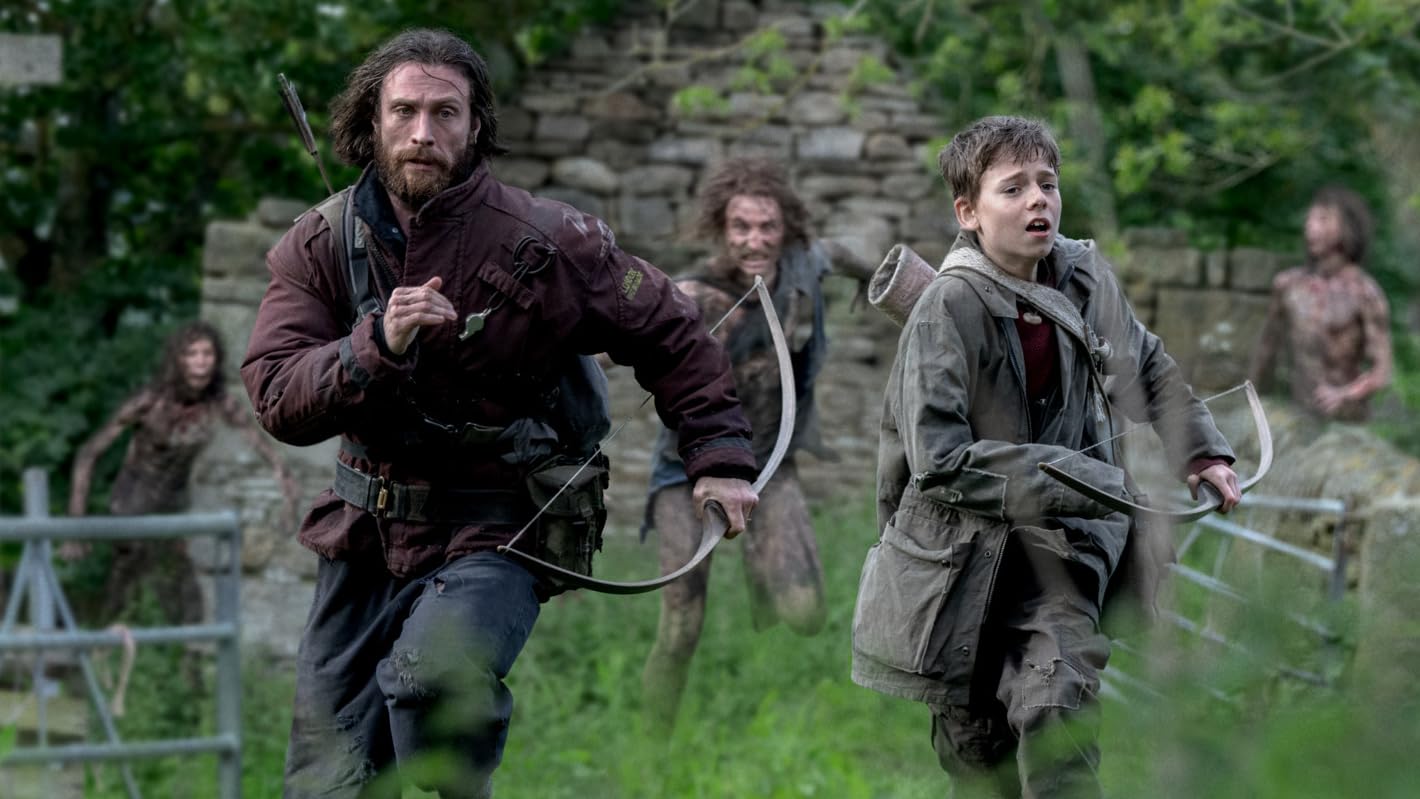
As the series jumps years into the future, 28 Years Later and The Bone Temple begin to delve into what the longer-term effects of a quarantined United Kingdom look like. Having been isolated since the outbreak, with boats patrolling the seas surrounding the UK, the remaining communities, like those on the island, have regressed to a primitive state in comparison to the wider world. Bacon is a privilege, fights are fought with bows, arrows and knives, and there isn’t a mobile phone or television in sight. In a community like this, those who venture onto the mainland to hunt are viewed as warriors, and Spike is thrown a party after his first trip, almost as if he’d come of age. However, such a regression like this has also meant that basic levels of medical treatment and assessment aren’t possible.
This leaves Isla, Spike’s mother, to rot and wither away under the trauma of a mysterious ailment affecting her brain. She often has waves of paranoia, anger or memory loss. This clearly plays a toll not only on Spike, but on his father Jamie. Without the wealth of options that modern-day society would afford, like treatment for Isla’s cancer, therapy for Jamie or wider social connections, Jamie turns to unhealthy means to solve his problems. It is clear that he has an issue with drinking, as evidenced at Spike’s party, but his worst and most inhumane choice is to have an affair with another of the locals on the island. While Isla’s condition is dwindling, it is a disrespectful decision to engage in an affair when he should focus on looking after Isla and keeping the family intact. While it would be understandable to seek human connection from others at that time, a romantic entanglement is a step too far. The affair also has wider complications for Spike who catches Jamie in the act, and later threatens him to stay away out of protection for Isla.
Jamie is also an example of toxic masculinity within a family unit. At Spike’s party, he boasts of his fighting prowess and spins lies about what he did on the mainland, all of which makes him deeply uncomfortable. To Jamie, being a warrior and a hunter is his identity, seeing the monsters he kills on the mainland as nothing more than targets, showing little remorse. This is an attitude he tries to force onto Spike, forcing him to execute a tied infected and pushing him onto the mainland years before he was ready. When Spike confronts Jamie for his infidelity, he hits him, showcasing that a cycle of violence is all he knows when it comes to holding back his emotions. When Spike forces him away, he refrains from hitting him again, instead punching holes in a wall. Jamie is a walking marker for the cycles of toxic masculitnity and violence, something that he attempts to pass onto Spike with little success.

Dr Kelson’s Bone Temple is an intriguing place that, in a normal modern day, would be seen as depraved. The burning of bodies, the monument to the dead, the ‘memento mori’ he preaches, would be seen as the ravings of a madman. However, in a world so wicked and backwards, it serves as a touching monument of remembrance and the suffering of both infected and uninfected alike. Kelson’s temple personifies a place of worship and faith, a church for the apocalypse. But its image of bone towers and skull pyramids is a reminder of how far humanity has regressed and divided itself in a time where unity was all that was needed. The community on the island is a rare example of human cooperation in the quarantined UK, and every skull on that monument tells a sad story. A lost mother, father, sister or son, someone taken too young or too vulnerable to protect themselves. Plenty of those skulls will have belonged to infected, true, but just as many will be those who suffered at the hands of the selfish, the desparate or the depraved, like the Jimmy gang.

Without delving too far into spoilers, the Jimmys are the most prominent example the 28 Days films provide of humanity’s regression. Jack O’Connell’s Jimmy Crystal emulates the visage of Jimmy Saville, a man we now know to have been a predator. However, in 2002, all we knew of the man was the children’s presenter, a revered figure of UK television. Jimmy uses his image, following years of unchecked youth and dwindling mental state, to pose himself as a prodigal son of Satan, using his ‘calling’ to excuse morally reprehensible acts of violence and torture. He has murdered and maimed in the name of falsehood, and what’s worse, has used his twisted image to lure others into his cult of personality as his ‘Fingers’. Jimmy weaponises the human need for faith and hope to twist those who are vulnerable and desire a purpose in a directionless world. The fact that, as a son of a priest, he wears his cross upside down is a subtle indicator towards his delusions and perversions, especially when you consider that he is a son of a priest. Jimmy uses the trauma of his childhood and redirects it at anyone in his way, corrupting or killing at a moment’s notice, and is a stark reminder of how far humanity can and has fallen in this world of the Rage Virus.
Bradley Whittam (born February 11, 2003) is a British film and television graduate, journalist and filmmaker. Having studied film since the age of 16, Bradley has since worked on several short films at university, primarily as an editor. He has also begun posting social media content surrounding films online.
@bradtalksfilm (TikTok), @_bradely_ (Instagram) and @bradwhitt03@outlook.com (email).
